Hello,
I am enjoying Kdenlive.
I just wanted to add a request for the Multicam Feature.
I do a lot and I mean a lot of Multicam setups and edits.
I work with many different cameras in one sequence.
Premiere pro has a good experience. (I have not tried Davinci Resolve so that might be better)
My request is to add a better Multicame workflow and features to support that.
Like for example, on Premiere Pro, you can put all your footage into one Sequence and then next that sequence into another one and then start switching to camera angle by switching which track its pulling from.
On Premiere Pro, you can just use the number pad by hand, which works great.
Can you add something similar to Kdenlive?
This is a big feature for me and I do a lot of editing on TV Shows and other big projects every day.
Thank you
In Kdenlive you have to start in the “multicam source sequence”. Here you can switch with the numpad key from camera to camera.
Once done you can select all clips and create a new nested sequence to have it lean. But this new sequence is “one block” of video and you don’t see the cuts anymore. So ripple in the nested sequence is not possible anymore for finetuning.
Yes, I am glad that this has been worked on.
I do think that is a problem, though. To not be able to go back and make changes and edits to the multicam sequence really hinders the power of multicam.
For now, until there is further improvement, I will to be able to use this.
I do believe that this will be possible eventually.
I think you may have misunderstood what Eugen said. You can always modify the multicam sequence. You just need to do it in that sequence. Any changes there will automatically be reflected anywhere it is nested if you use that additional optional step.
I think i do understand it. I am not saying its impossible to go back and make changes in KDElive. I think what i am trying to say is how many steps are involved to make changes.
I very busy so i dont have a lot of time to go into this but if you study how to do multicam in Premiere pro, then that should explain it best.
i have to work on multicam every day, i have a lot of work i do with multicam.
The workflow is really good in premere pro and would love to see that in KDElive.
if i get some more time, i will do my best to give examples.
The goal here isn’t to just clone what other editors are doing, it’s to explore and do what is best for us and our users. So it’s good to differentiate between what people find difficult at first because it’s different to some other tool they have come from, and what is more difficult than it could be because there really is some better way we could be doing something.
Yes, i agree, we should not want to clone what other software does, instead we should want to take what they did and make it a 1000 times better then what they made. Build upon what they did and make it better.
make KDE easier to use, but more powerful at the same time.
Here is a video of the current workflow of multicam editing. this is what i do on a basic level. now i have a lot more tracks of video and audio so being able to do this has been helpful.
Thank you for looking into this and pointing me toward the documentation! I appreciate that the team is working on this.
To help explain why the current implementation is difficult for heavy multicam workflows, it comes down to fine-tuning and non-destructive editing.
In professional editing (like TV shows or long-form multicam events), the first pass using the numpad to switch cameras is just a rough draft. The real work happens afterward during the polishing phase.
Here is why the ‘nested sequence’ workaround falls short for that workflow:
Loss of Cut Visibility: When you collapse the clips into a nested sequence ‘block’, you lose the visual timeline markers of where the camera cuts actually occurred. To tweak a cut, you have to open the source sequence, guess where you were, make the change, and jump back.
Inability to Ripple Edit / Fine-Tune: If a camera switch happens 5 frames too early, in Premiere Pro I can simply use the ripple/rolling edit tool directly on the cut in the master timeline to shift the edit point left or right. In Kdenlive’s current nested state, you cannot ripple or fine-tune cuts on the main timeline because the individual cuts are hidden inside the block.
Changing a Camera Angle Post-Cut: If I decide later that ‘Cut #4’ should have been Camera B instead of Camera A, I want to be able to right-click that specific cut segment on my main timeline and change the angle instantly, or just press a number key over that clip. Nesting the sequence prevents this quick adjustment.
The Ideal Solution: Instead of forcing the user to collapse the edited clips into a single nested block to keep the timeline ‘lean,’ Kdenlive needs a way to treat a Multicam Target Clip as a single track that retains its individual cut boundaries. You should be able to see every cut on the timeline, drag the edit points to fine-tune the timing, and change the camera angle of any individual cut at any time without altering a nested container.
Essentially, the multicam cuts should live on the main editing timeline natively, rather than being locked away inside a nested sequence.
I hope this helps clarify the workflow bottleneck! Thank you again for your hard work on Kdenlive.
I checked the workflow in Premiere and Davinci and your three points are essentially what’s missing in Kdenlive. Premiere and Davinci are somehow working with an editable sequence for mulicam. For me it’s not so “visible” what happen.
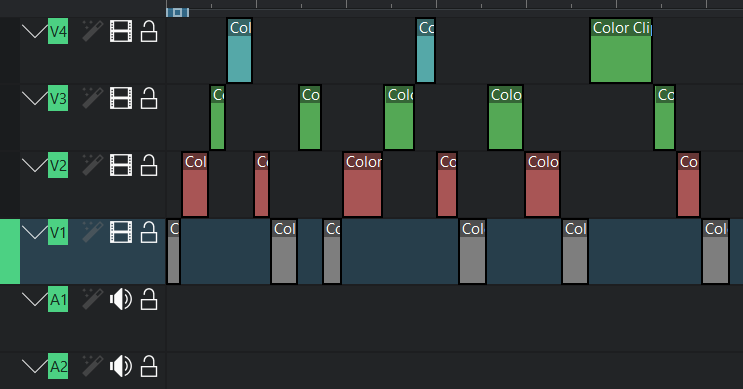
I think we could improve Kdenlive by two additional functions. After the first pass using the numpad to switch cameras for a rough draft we end up like this:
This is amazing! You have captured the exact core of the problem perfectly. The workflow you laid out with the screenshots, is an excellent way to handle the timeline side of things.
Looking at your ideas, it brings up a broader architectural concept that I think is the real key to solving multicam, and it would drastically improve Kdenlive across the board: Flexible Timeline Containerization.
When you look at how Premiere and DaVinci handle multicam, they treat the multi-track source footage as a live, editable container (a nested sequence) that acts like a single clip on the main timeline.
If Kdenlive can master this kind of deep containerization—where a nested sequence isn’t just a static ‘one block’ render, but a live, dynamically editable container—it solves multicam and unlocks a massive world of features for editors:
Advanced Multicam: We can step ‘inside’ the container to adjust camera sync, audio tracks, or color grading, and those changes instantly reflect on the main timeline without losing our cut boundaries.
Organization for Large Projects: Editors can collapse massive, complex multi-layered scenes (VFX heavy shots, graphics, b-roll layers) into a single container clip to keep the main timeline clean, but still step inside to tweak individual layers at any time.
Reusable Sequences: You can build a complex intro, lower-third graphic, or credit sequence as its own timeline container and drop it into multiple different edits. If you change a typo inside the container, it updates everywhere automatically.
Audio Bus Management: You can group entire multi-track audio dialogues or sound effects layers into a single container track to apply effects or volume adjustments to the whole group at once.
Your proposal to flatten the clips to V1 while keeping the camera info is a brilliant, elegant way to handle the cut workflow. If we combine that UI approach with a robust backdrop of live, editable timeline containers, Kdenlive’s editing power would instantly rival the industry standard.
Regarding the monitors and the MLT framework—don’t let that stall your progress on this. Getting this timeline behavior and container logic down is 90% of the battle, and it will revolutionize the software even if we are looking at a single monitor preview for now.
Thank you for digging into this with such great visual concepts!
@berndmj regarding open Multicam tickets in Bugzilla, can we make a meta ticket for them? AND/OR have a label for them to easily find ? (Bugzilla bugs are rotting in the Bugzilla bugtracker.)