
Due to poor UI design it is unclear which of the two maximises system stability. Also it fails to state why and how.
After rebooting maximizes stability because it ensures the OS is using the latest updated packages.
unfortunately, this means that you must interrupt your work to reboot which can break workflows and in that sense of the word “stability” it has a negative effect.
it also means (that in discover at least) you do not get any visibility to what is being updated, everything from library updates to whole new kernels are wrapped up in a single line item called “system update”
many want to see what is going to be changed before they accept the update, esp those using nvidia GPUs because sometimes those updates can be more disruptive than just a reboot and are best put off until you have a natural break in your workflow to deal with the unexpected.
—
my preference is to use Immediately so that i’m in control of when i reboot and so i have visibility in discover to what is being updated.
when i see a new kernel come in, then i know that i should wrap up what i’m working on and reboot as soon as possible, and i’m prepared to deal with any issues that might arise.
but if its just a python library update, i will simply apply it and get on with my day… which in my view is a more stable existence.
If you’re a normal person: “after rebooting”.
If you’re an expert: still “after rebooting”, especially if you’re the kind of person who likes to maximize uptime.
I imagine some indenting on the “recommended…” line would make it more clear which option it belongs to, maybe.

But I also imagine that most people associate the smaller text with following content from above as opposed to preceding the content below.
Rather a small bug or typo or similar thing, if you ask me.
Or
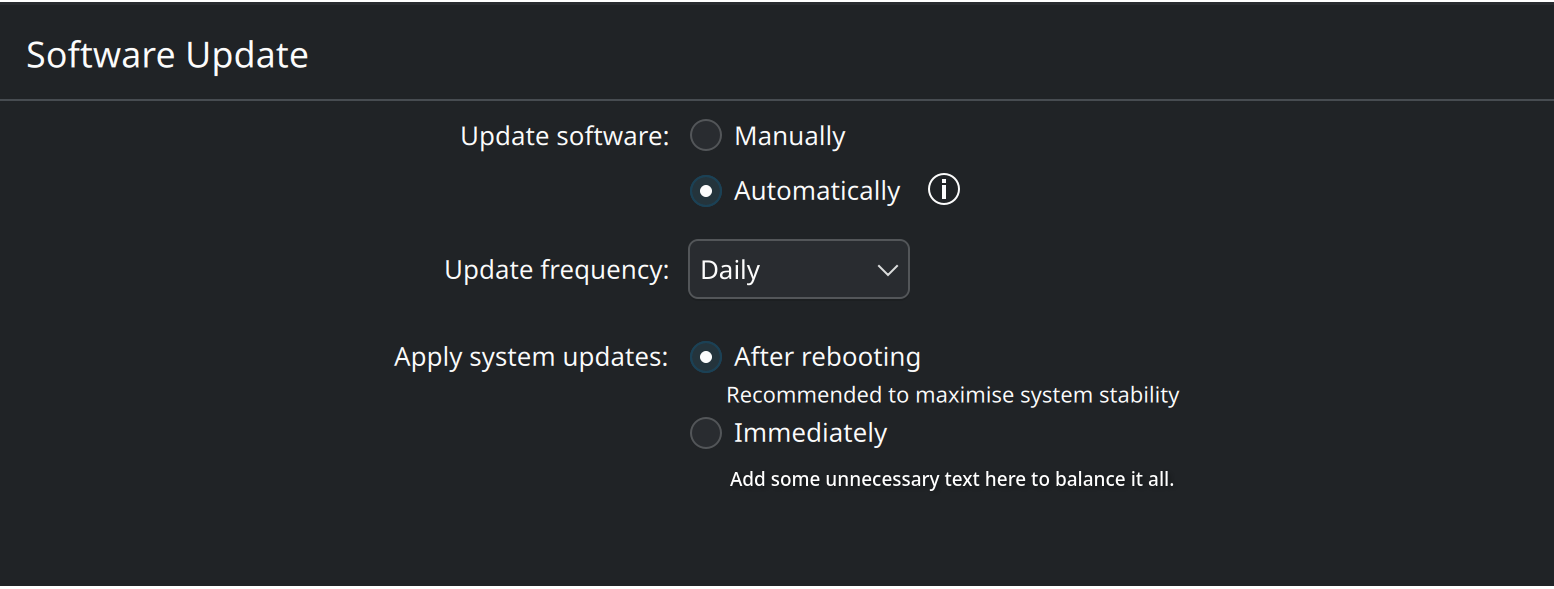
Just pretend I used the correct font size of course. I am no UX designer.
You indeed got the irritation I try to convey. Programmers assuming too much is a dangerous thing.l
A smaller print would be a footnote referring to the line above, an equal sized bold font would be a heading referring to the line below. But if I would mentally place a : behind the note it would refer to the next line.
But now I am assuming things..
Your solution would just make it clear beyond doubt.
You might be right, but if things go wrong and stop working normally we generally ask the (rather silly) question if the user changed anything before the error appeared. If waiting for a day or a couple of hours user most likely won.t remember they made a disruptive change.
If a “reboot after updating” system update breaks things, it’s most likely a problem coming from the OS vendor. It would need to be reported to them so they can fix it.
And ideally we’d all be choosing and using operating systems whose updates aren’t causing breakage. 